
Theme Through Behavior: Scene Checklist
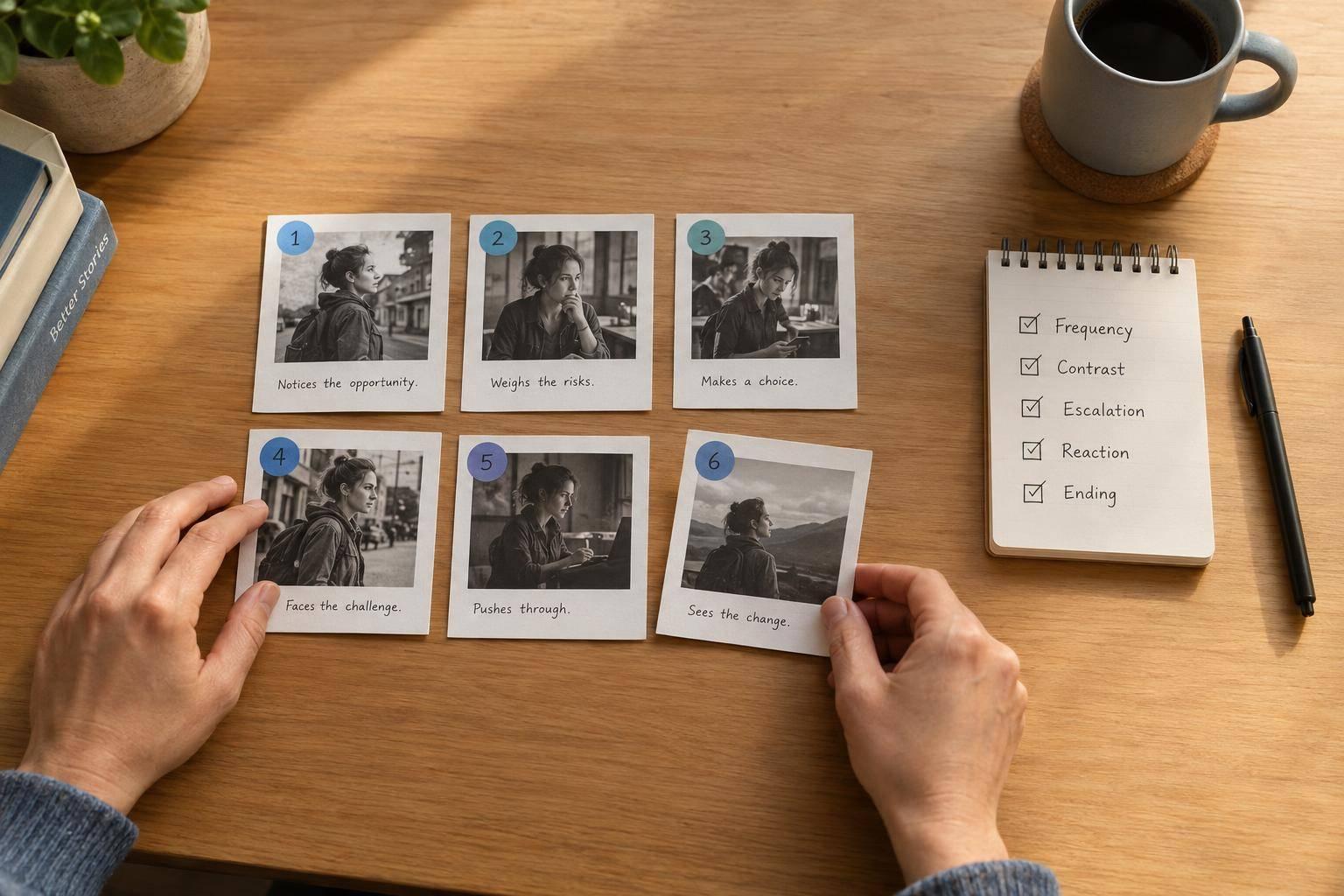
Theme Through Behavior: Scene Checklist
I test a script’s theme by tracking choices - not speeches. I start with one repeated behavior and note what the character wants, what they reject, and what happens next.
Then I check 5 things:
- Frequency: Does the behavior return often enough to form a pattern?
- Contrast: Do different choices show other answers to the same dilemma?
- Escalation: Does repeating the behavior become harder or cost more?
- Reaction: Does it change what other characters do?
- Ending: Does the final choice break or confirm the pattern - and carry a cost?
My revision rule: <u>fix cause and effect before polishing dialogue</u>. If a repeated choice changes nothing, I cut it, combine it with another beat, or change its outcome. The goal is progress in meaning, not more repetition.
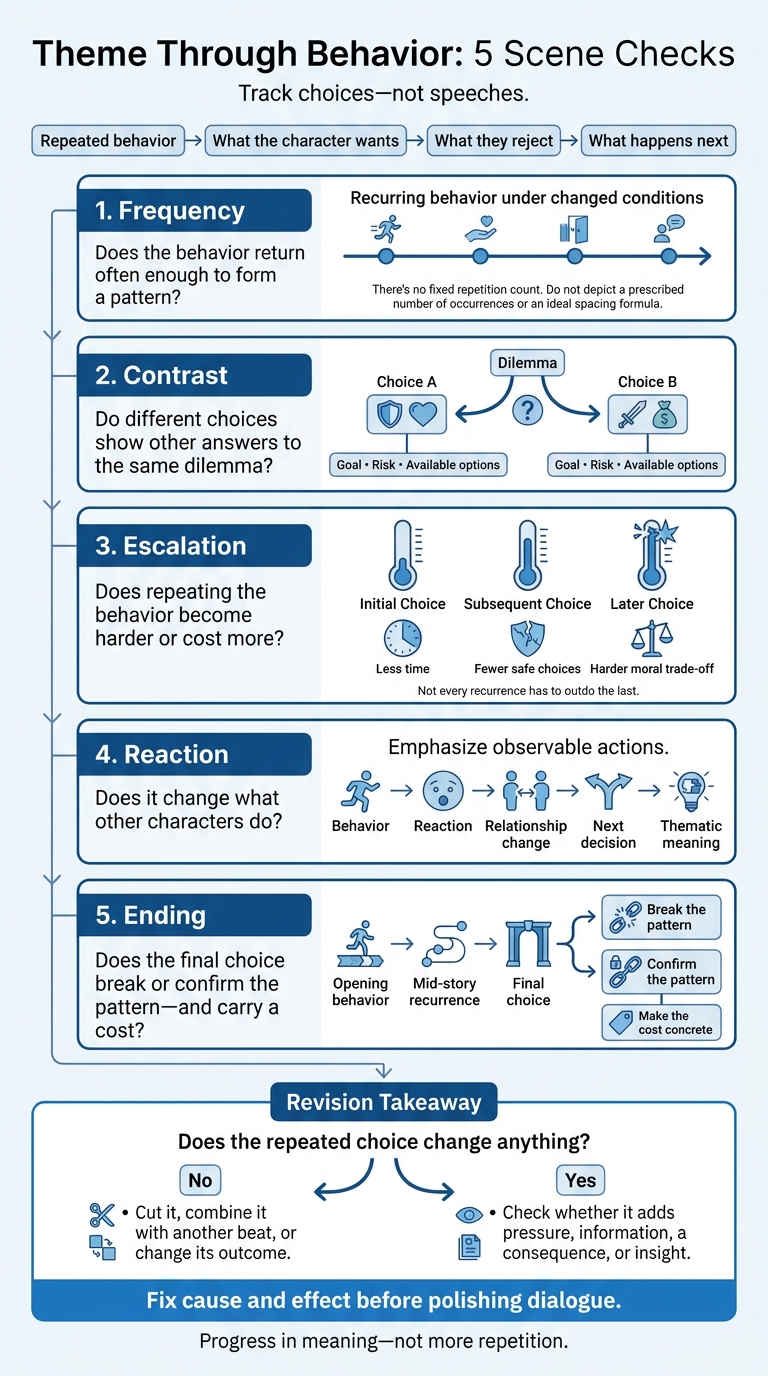
Theme Through Behavior: 5 Scene Checks
Discover the Use of Theme for Better Screenplays
sbb-itb-609c31f
Frequency: Is There a Clear Pattern?
Use the tracker to check how often the behavior returns - and whether those returns help the audience recognize a pattern.
There’s no fixed repetition count. Frequency depends on the script’s length, genre, pacing, and the behavior’s dramatic weight. Let the audience see the pattern in action before its meaning becomes explicit.
Check the Spacing
Log each occurrence and compare the gaps. Long gaps can make the pattern harder to recognize; tight clusters can feel mechanical. Let the drama guide the spacing: establish the behavior, give its consequences room to develop, then return to it under changed conditions.
For each return, check:
- [ ] Early setup: Does the behavior appear before the central conflict makes it unavoidable?
- [ ] Varied appearances: Does it return in different settings, relationships, or pressures?
- [ ] Want or fear: Does it connect to what the character wants or fears in this scene?
- [ ] Recognition through action: Can the audience spot the pattern without explanatory dialogue?
- [ ] Something new: Does this return add pressure, information, or a consequence?
- [ ] No redundant beats: Can you combine or cut repetitions that do the same dramatic work?
After the first two or three relevant scenes, check whether the audience can predict the kind of choice, but not its cost or outcome. If the pattern is unclear, strengthen the setup. If the next beat adds no new risk, change the pressure. Once the pattern is clear, check whether different situations lead to different choices.
Contrast: Do Choices Show Different Answers?
Repeated behavior can mean something different when conditions change. Pair scenes and note what each choice suggests the story values, challenges, or condemns. Then test whether changed conditions lead to different thematic answers.
Check Opposing Choices and Changed Conditions
- [ ] Same character, different answer: Does the later choice show growth, contradiction, or self-deception? Note what changed in the character’s beliefs or circumstances.
- [ ] Another character, viable alternative: Does a foil or ally act differently when facing the same dilemma? Give that alternative a believable motive and a consequence - not just a weak argument.
- [ ] Comparable pressure: Compare each character’s goal, risk, and available options. If one can safely refuse and another cannot, account for that difference before treating their choices as moral opposites.
In The Big Sick, Kumail hides his life, Emily ends the relationship after learning the truth, and Terry admits an affair. The contrast shows avoidance, boundaries, and vulnerability under different stakes.
If the contrast changes the stakes, use that difference to set up the next pressure test.
For each scene pair, check who is watching, who holds power, and who can leave or refuse. Does the setting change how visible or risky the action is? Does the relationship make the choice protective, controlling, or disloyal? Record both the immediate benefit and the later damage. A choice that works now may still come at a cost.
Check whether viewers can read the difference without dialogue. Use distance, entrances, exits, or an accepted or rejected object to show what the choice means thematically. Keep contrasts that offer a real alternative; cut scenes that repeat the same answer in a different setting.
Escalation: Does the Cost Increase?
After contrast, check whether the same behavior now costs more. That cost might mean less time, fewer safe choices, or a harder moral trade-off. Label scenes as establishing, testing, contrasting, escalating, or turning so quiet beats don’t get dismissed as filler. Escalation should deepen the theme, not just increase the stakes.
Check Pressure, Choices, and Consequences
- [ ] Pressure: Pinpoint the tighter deadline, reduced resources, or stronger opposition that makes the objective harder to reach.
- [ ] New obstacle and turn: Does the character need a different tactic? Does the scene end with a change in control, information, stakes, or plan?
- [ ] Costlier choice: Does continuing the behavior now put trust, self-respect, or someone else’s safety at risk?
- [ ] Lasting consequences: Track who knows, who gets hurt, and what can’t be repaired. Does the damage become more public, last longer, or affect more people?
- [ ] Cause and effect: Does the choice cause the next problem? Separate the results of the character’s behavior from unrelated bad luck.
A character who protects a company may ignore misconduct, falsify a report, then frame a coworker: same behavior, rising cost.
In your tracker, end each escalating scene with Next harder choice: If several rows name the same choice, revise the obstacle or consequence. Keep an establishing or contrasting scene when it adds needed information; not every recurrence has to outdo the last. Then move to reaction: who feels the increase first?
Reaction: How Does the Behavior Affect Others?
After escalation, track who feels the cost first and how it changes the scene. Silence counts when it changes an interaction. An unspoken feeling alone does not.
Check Responses and Relationship Changes
- [ ] Notice and respond: Does someone resist, reward, copy, fear, or exploit the behavior? Show it through speech, distance, eye contact, withdrawal, or another concrete action. Include misunderstandings that prompt action; skip dialogue that only explains the theme.
- [ ] Reveal a cost or benefit: Label the response as a cost, benefit, mixed result, or opposing interpretation. Does it challenge the protagonist’s belief?
- [ ] Change the relationship: Identify a shift in trust, access, loyalty, authority, or intimacy. Show it in a later interaction.
- [ ] Prompt a decision: Does the responding character change a plan, set a boundary, withhold information, or add an obstacle? Root that choice in their own needs.
Track the Reaction Chain
Trace how one behavior changes another character’s next move. Use one row for each meaningful recurrence. Add scene numbers in the cells to link delayed reactions to their cause.
| Behavior | Reaction | Relationship change | Next decision | Thematic meaning |
|---|---|---|---|---|
Flag any row without an observable consequence. Mark it later, too weak, redundant, or missing. For a delayed response, name the payoff scene and the exact action that follows.
Check whether the audience can connect the response to the earlier behavior. If the link needs work, add a brief callback or visible choice - not a speech explaining the theme. Use “Thematic meaning” only for a direct theme signal. Remove rows that merely restate the plot.
Try removing the behavior. Would the same relationship shift, plot event, and next decision still happen? If so, strengthen the response or question whether the repetition serves a purpose. Check what the reaction makes someone do next, even if that action comes several scenes later.
Final Reversal or Confirmation: Does the Ending Test the Theme?
Compare the character’s opening behavior, a mid-story recurrence, and the final choice. Map each as situation → pressure → choice → consequence. Note what changes: the action, the motive, or the cost.
Check the Final Choice and Its Cost
- [ ] Test competing values: Does the climax force a choice tied to the thematic question? Name what the character risks: safety, trust, status, freedom, or control. Remove easy escapes that let them protect both values without giving anything up.
- [ ] Earn the outcome: Does earlier behavior set up the reversal or confirmation? Point to a prior choice that makes the ending believable. A sudden change takes more than a last-minute realization.
- [ ] Make the cost concrete: What does the character lose or risk? What changes afterward? A symbolic gesture counts only if it changes their options, relationships, or future actions.
- [ ] Identify the ending’s stance: Does the character break the pattern, knowingly repeat it, or repeat it at a tragic cost? Show the alternative they reject.
- [ ] Keep ambiguity deliberate: If the theme stays unresolved, identify evidence for each reading. The audience should understand the choice and why it matters, even when its meaning stays open.
Read the ending with the theme statement covered. Can you identify what happened, what the choice reveals, and what remains unsettled? If not, sharpen the decision or show its consequences rather than adding explanation. Use this test to pinpoint what the revision pass needs to fix.
Use the Checklist to Revise
Fix cause and effect before polishing dialogue. That way, repeated behavior still carries the theme. Start with missing consequences: make the behavior change a relationship, a risk, or a future complication in the same scene or the next. Note what’s different when the scene ends, then revise later scenes that depend on that change.
Next, compare repeated beats. If the pressure, choice, and outcome stay the same, cut or combine scenes - or change the conditions so the next repetition demands a different response. If the ending feels unprepared, work backward. Mark where earlier actions need to set up its pressure, alternative, and cost. Give each gap a specific revision task rather than a broad note to “strengthen theme.”
After those repairs, read the full draft without editing. Update the behavior tracker to reflect the whole pattern. Check whether added setup slows the story, a cut removes needed contrast, or a new consequence puts later reactions out of step. Use those notes to pinpoint the scenes that need more work.
Track Revisions in Scriptwood
Use Scriptwood to mark scene rows where behavior doesn’t change pressure, choice, or consequence. Add inline comments beside tracker rows that fail the frequency, contrast, escalation, reaction, or ending checks. Then test changes in the screenplay editor or through AI scene rewrites. Before accepting a script coverage suggestion, trace it to an action and outcome.
Save a new draft before revising. Use draft comparison and draft history to compare the changed setup with the final payoff - not just the rewritten scene. Check whether the behavior still escalates, creates contrast, and resolves the theme. Review cuts as closely as additions: a tighter scene can still erase a reaction or choice the ending needs. Use these draft checks to see where the pattern holds and where it still needs work.
Conclusion: Keep or Revise the Pattern
Keep repetition only when it deepens meaning: frequency establishes the pattern, contrast tests alternatives, escalation increases the cost, reaction shows the impact, and the ending confirms or reverses the theme.
Use gaps as prompts for revision, not speeches about the theme. Mark a behavior underdeveloped if it appears too rarely or never changes. Mark it decorative if it repeats without a new obstacle, consequence, or insight.
Pick the weakest scene in your tracker and give it one job. Then reread the tracked beats in order. Keep the pattern only if its meaning progresses - not just its frequency.
FAQs
How do I choose which behavior to track?
Start with the protagonist’s three key decisions: their first major choice, their midpoint choice, and their choice at the climax. Check whether each action holds up against their opening belief when pressure hits.
Track other choices that establish, test, or force a change in that belief, too. Pay close attention to decisions with clear costs or consequences.
Scriptwood’s scene coverage can help you review these choices.
Can one behavior support multiple themes?
Yes. One action or scene can test a protagonist’s internal need, expose a flaw, and show what happens as their beliefs change.
For example, hiding the truth can show both the personal cost of ambition and how integrity erodes.
The Scriptwood screenplay editor helps you track these layers so your scenes support your themes without leaning on thematic speeches.
How do I test theme in an ensemble cast?
Build a scene-by-scene reverse outline that tracks each major character’s belief under pressure. Note what challenges that belief, how the character tries to protect it, and what that tactic costs them.
Compare behavior across characters and scenes. Look for repeated responses, differences in tactics or values, rising costs, and later reactions that reveal the effects of earlier consequences.
At the final choice or reversal, check whether actions and outcomes answer the story’s thematic question by confirming or reversing the pattern.