
10 Revision Priority Note Examples for Scripts
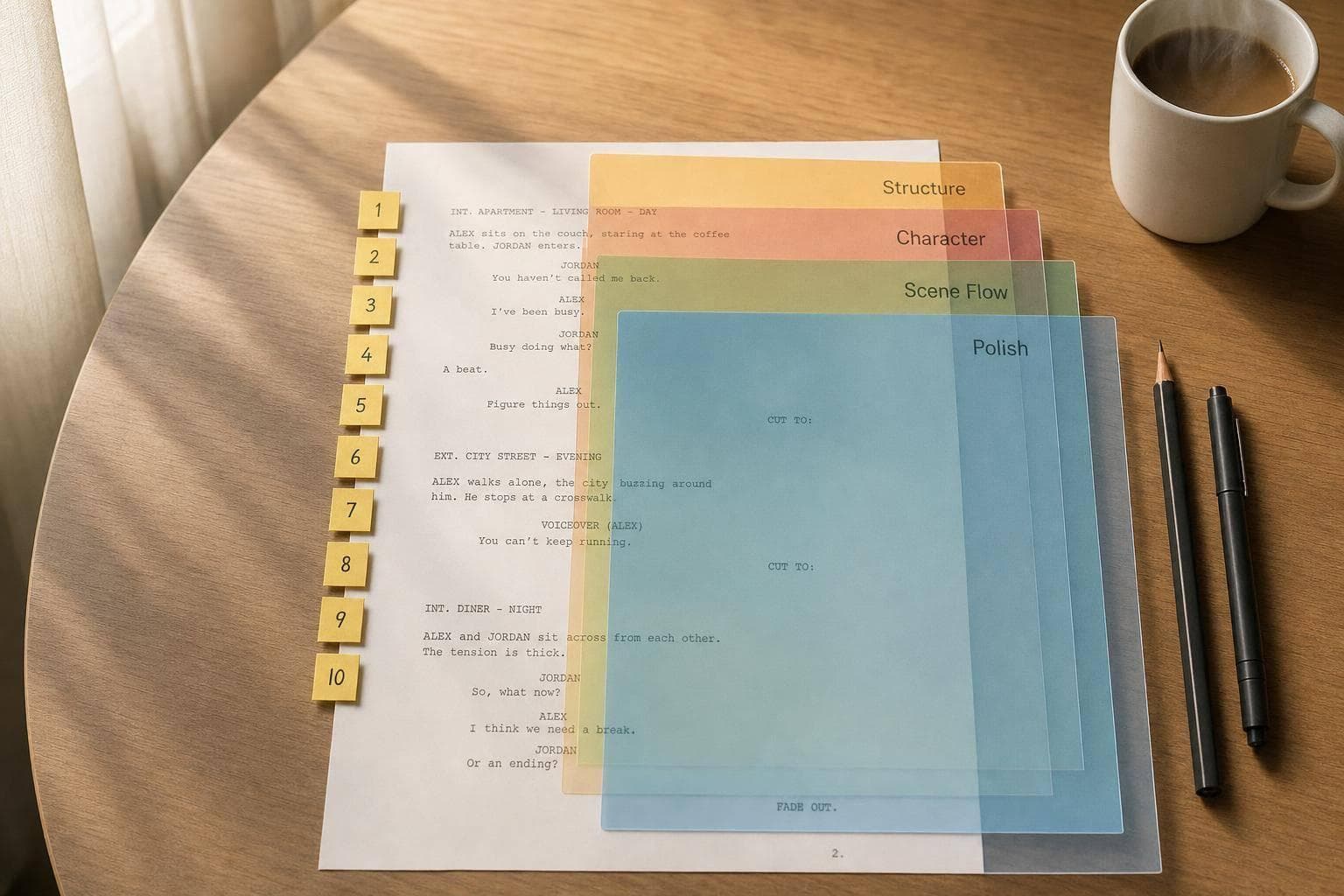
10 Revision Priority Note Examples for Scripts
If I get 10 script notes at once, I don’t treat them equally. I fix the issues that change the whole draft first, then move to scene work, and only then do line polish.
Here’s the short version: this article ranks 10 common revision notes by impact, from act structure and stakes to dialogue, tone, and market appeal. The core idea is simple: if one note affects half the script, it comes before a note that fixes one scene or one line.
In practice, that means I’d revise in this order:
- Broken act structure
- Weak stakes
- Unclear protagonist motivation
- Confusing scene order
- Flat character arc
- On-the-nose dialogue
- Uneven tone or genre
- Redundant scenes
- Weak climax
- Market appeal and final rating
A common rewrite split is 4 passes: story, character, scene flow, and polish. That approach cuts wasted work because I’m not polishing pages that may get moved or cut later. In plain terms: big story problems first, small wording fixes last.
| Note Type | What it affects | When I’d fix it |
|---|---|---|
| Story and plot | Whole script | First |
| Character logic | Main arc and choices | Second |
| Scene flow | Readability and pace | Third |
| Dialogue and wording | Surface polish | Last |
If you want a clean rewrite plan, this article gives you that order from start to finish.
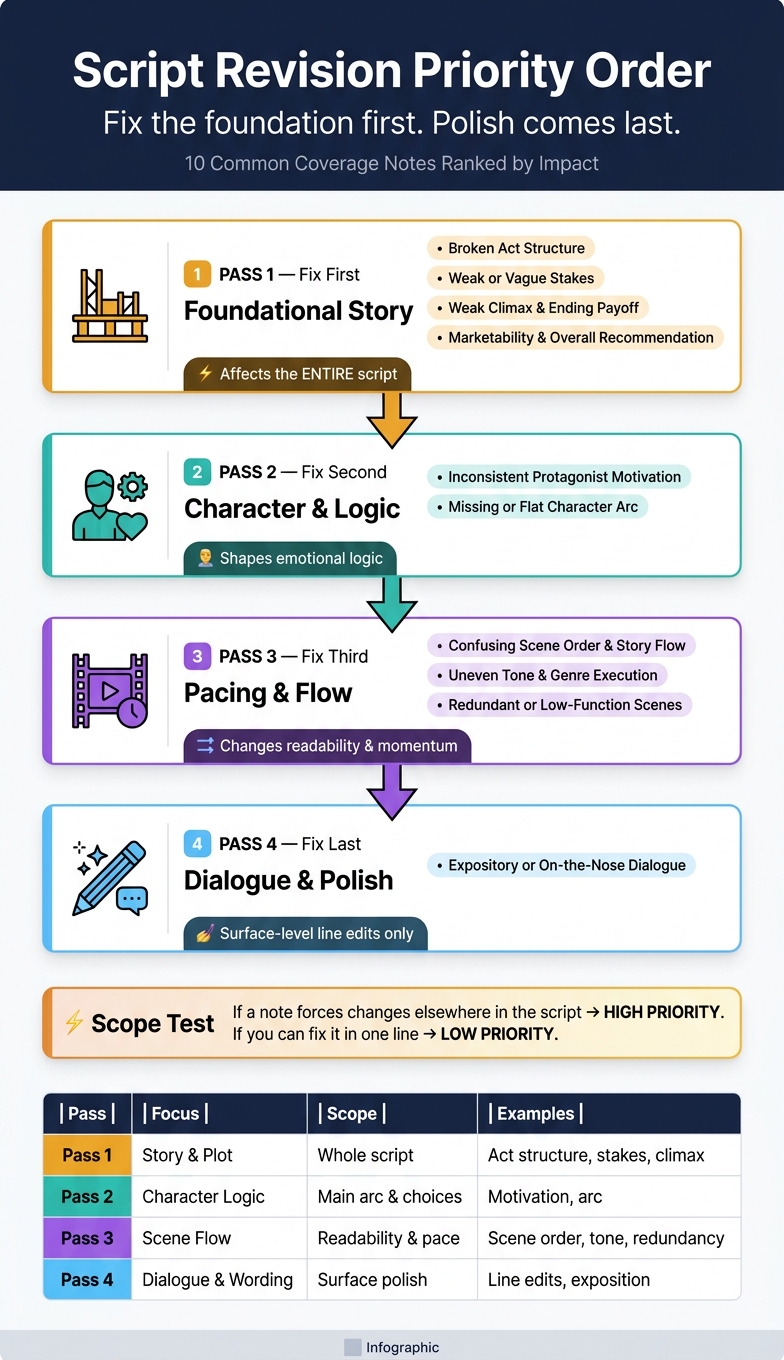
Script Revision Priority: 4-Pass Rewrite Framework
Screenwriting Notes Explained | Rewrite Your Screenplay Like a Pro
sbb-itb-609c31f
What Revision Priority Notes Do in a Rewrite
Priority notes save time in a rewrite because they rank problems by impact. That means you handle big structural issues before you spend energy polishing dialogue.
Why does that matter? Because one weak spot in the structure can throw off pacing, character work, and scene flow across the whole draft. If the foundation is shaky, later scene-level edits may not matter much.
This ranking also turns scattered feedback into a plan you can actually use. Instead of staring at a pile of notes and wondering where to start, you get a clear order of attack.
Professional coverage usually sorts those priorities into clear categories, which makes the rewrite process feel a lot less messy.
How Professional Script Coverage Organizes Notes
A standard coverage report follows a clear structure. Once you know the layout, it gets much easier to spot the notes that matter most for your rewrite.
It usually begins with the top sheet, which lists the title, genre, author, and overall ratings.
Next comes the logline, which tests the core idea, and the synopsis, which shows whether the plot holds together from start to finish.
The most important part of the report is usually the comments and element analysis sections. Comments spell out the problems in plain language. Element analysis scores each craft area. Put those two together, and you can see which part of the script is pulling everything else down.
All of that leads to the final verdict: Pass, Consider, or Recommend. That rating reflects the combined scores and comments. The notes that should shape your revision plan usually sit inside the comments and element analysis, where readers flag the problems standing in the way of a better verdict.
Scriptwood delivers two separate documents - a Coverage PDF for the industry-facing evaluation and a Writer Feedback PDF focused on craft revision - so the distinction between high-priority story problems and lower-priority polish notes is built right into the format.
With that map in mind, the next step is reading the notes from the biggest problem to the smallest fix.
How to Read Priority Notes from Biggest Problem to Smallest Fix
Read priority notes by scope: start with whole-script problems, move to sequence-level issues, and save line-level polish for last. The idea is simple: fix the foundation before you polish the dialogue.
| Priority Level | Focus Areas | Scope of Impact |
|---|---|---|
| High | Act structure, character development, stakes, marketability | Affects the entire narrative foundation |
| Medium | Pacing, scene flow, genre execution | Affects reader engagement across sequences |
| Low | Dialogue cleanup, trimming, isolated scene fixes | Surface polish, line edits |
That ranking is the same order used in the examples that follow. It gives you a clear way to decide what to tackle first in features, pilots, and shorts.
Here’s a simple rule of thumb: if a note forces changes in other parts of the script, it’s high priority. If you can fix it in one line or one beat, it’s low priority.
Use this scope test to read the 10 examples below in order.
1. Broken Act Structure
Broken act structure is a top-priority note because it weakens the story’s spine. And when the spine is weak, every later rewrite gets harder.
"The act turns are too soft; the story needs a clearer structural shift to build momentum."
A note like this points to a structural rebuild, not a simple polish pass. In coverage, structure is treated as a core story problem. If the act turns don’t land, pacing slips, stakes lose force, and scene flow starts to drag.
Once the act turns are clear, the next question is whether the stakes are strong enough to carry them.
2. Weak or Vague Stakes
Weak or vague stakes often get flagged in coverage as structure and character problems. And for good reason: they drain urgency and soften the script’s punch. This isn’t the kind of thing you fix with a few line edits. It usually calls for a rewrite, not a polish pass.
That’s why it helps to deal with stakes early, before you start tightening dialogue.
If the protagonist doesn’t have much to lose, their motivation can feel thin, shaky, or all over the place. When that happens, the next problem usually shows up fast: protagonist motivation.
3. Inconsistent Protagonist Motivation
Inconsistent protagonist motivation is easy to miss. The character’s why doesn’t usually snap in half. It fades. It gets weaker scene by scene.
That’s why this issue can feel slippery. The stakes may be clear, but the lead still feels a little off. When that happens, the problem is often the motivation, not the premise.
Coverage often flags this under Characters, Structure, or Marketability. For example, a character may move from resistance to attachment without a clear trigger, so the shift doesn’t feel earned. And when the protagonist’s why isn’t clear and steady, the story can start to feel unearned.
The fix starts with structure, not dialogue. Tighten the motivation first, then polish the lines. This belongs in your character and structural rewrite pass, not your line-level polish pass.
Scriptwood can help flag inconsistent motivation by looking at character development and marketability together. Once the motivation is stable, check whether the scene order backs it up.
4. Confusing Scene Order and Story Flow
Scene order problems can make a script feel slow or disjointed. The issue usually shows up when a scene arrives before the audience has the context to understand it. When that happens, fix the order first. Then worry about cutting scenes.
In professional coverage, this usually gets flagged under Structure and Pacing. But when you rewrite, don’t get stuck on the label. Focus on the action: figure out which scenes are landing out of sequence and why.
A good priority note here stays on story flow, not line-by-line polish. For example, a coverage note might point out that an emotional confrontation happens before the relationship has been set up, so the scene loses some of its punch. The fix is structural: move scenes that introduce new information so they come before scenes that depend on it. Once the order makes sense, it becomes much easier to judge what the scene is doing.
The best fix is simple: move scenes until each reveal lands after the setup it needs.
5. Missing or Flat Character Arc
A flat arc means the protagonist reaches the end of the script still carrying the same worldview and the same fear they had at the beginning.
"The ending does not force a meaningful internal choice, so the arc feels unfinished."
That note gives you a clear way in. Start with the blocked belief. What idea, fear, or old wound is stopping the character from changing? Then look at the climax and ask a simple question: does this moment force that belief to crack, or not?
If not, that's where the rewrite should start. Fix the inner obstacle first. Name the fear or belief holding the character in place, then make the climax challenge it head-on. If that shift never shows up on the page, the arc will feel incomplete no matter how much action surrounds it.
And if the arc is working, the next thing to check is whether the dialogue backs it up.
6. Expository or On-the-Nose Dialogue
Dialogue is one of the main things readers look at in coverage, and on-the-nose lines usually point to a bigger issue under the hood. If characters are saying exactly what they think, feel, or need, the problem often isn't just the wording. It's usually tied to character, tension, or story setup.
Dialogue notes matter most when they affect character truth, scene tension, or story clarity. That means this is a rewrite-pass problem, not just a quick line edit.
Handle it at the scene level after structure, stakes, and motivation are locked in. Then use the dialogue pass to keep the subtext alive and work exposition into action, instead of having characters spell everything out.
Weak dialogue alone can be enough to push a script to Pass, even if the rest is in good shape. Fix the dialogue pass first. After that, move to tone and genre execution.
7. Uneven Tone and Genre Execution
Coverage flags tone when a script starts drifting away from the genre it promised in the first place. And that matters for one simple reason: genre execution affects marketability. So this is rewrite-pass work, not polish-pass work.
A note might say the script never fully commits to its genre, or that the tonal mismatch needs a closer read. When that happens, find the exact point where the drift begins. Then make the hard call: cut the scene, rewrite it, or rework the run of scenes around it.
Genre blends like supernatural horror-comedy are especially fragile. They can work, but the balance is easy to lose. One scene leans too far into jokes, another plays the fear too straight, and suddenly the script feels like it’s speaking in two voices. Use your combined read of structure, pacing, and marketability to spot the first tonal break.
If the tone is steady but the script still feels slow, the next issue is usually redundant scenes.
8. Redundant or Low-Function Scenes
A redundant scene repeats information, emotion, or conflict without moving the plot forward or adding to a character’s arc. In coverage, this usually gets flagged as a pacing or structure issue. The fix is pretty simple: cut the scene or merge it with another one before you spend time polishing dialogue.
If a scene only tells the audience something they already know, it shouldn’t sit near the top of your rewrite list. Structure, stakes, and character motivation come first.
A coverage note on this point will usually say that repeated beats are slowing the script down and need to be cut or combined. That’s a scene-level fix. It changes pacing and structure inside a sequence, not the premise of the whole story. Once those redundant scenes are trimmed, the next thing to tackle is the ending payoff.
9. Weak Climax and Ending Payoff
A weak climax is usually a structure problem. The final confrontation shows up too soon, and the resolution can feel unearned because the protagonist's choices and inner conflict weren't set up well enough. This is a high-priority rewrite issue.
In professional coverage, this kind of problem usually falls under Structure or core story elements. When the ending misses, the script's payoff feels incomplete.
When you revise, start with the protagonist's final decision. Does it grow out of what the script set up earlier? If not, the fix usually lives earlier in the draft - in the setup, the character's motivation, or the order of scenes.
If the climax still feels soft after those changes, the next thing to look at is how the script positions itself overall.
10. Marketability and Overall Recommendation
Marketability sits near the top of the list because it can sink a script even when the writing is clean. At this level, the question is simple: who is this for, and does it have real market appeal? If the answer feels shaky, the note usually points to a weak hook, an unclear audience, or a premise that feels too familiar. And yes, that call often shapes the final Pass, Consider, or Recommend.
A script can have polished prose and still get a Pass if the hook is weak or the audience isn't clear. That's why marketability is a rewrite-level issue, not a line edit. You don't fix it by tweaking dialogue or trimming a scene here and there. You look at the big picture and compare it against the other top rewrite priorities.
"A unique concept - such as a detective duo split between the living and the dead - shows how a fresh hook can sharpen marketability."
Scriptwood's coverage reports put marketability right alongside structure, characters, and pacing. That makes it easier to rank revisions by impact instead of guessing what to fix first. Use that lens in the quick-reference table below.
High-Priority Story Notes vs. Lower-Priority Polish Notes: Quick Reference Table
Use the scope test above to sort notes into four rewrite passes.
| Note Category | Note Focus | Impact on Script | Suggested Rewrite Pass |
|---|---|---|---|
| Foundational Story | Act structure, stakes, climax, ending payoff, marketability | Decides whether the script works at all | Pass 1: Structural / Developmental Pass |
| Character & Logic | Protagonist motivation, arcs, consistency | Shapes the emotional logic | Pass 2: Character / Development Pass |
| Pacing & Flow | Scene order, redundant scenes, tone | Changes readability and flow | Pass 3: Scene-Level Edit |
| Dialogue & Polish | Expository dialogue, line-level cleanup | Tightens the voice | Pass 4: Final Polish |
Use this table to rank notes before you build your rewrite plan.
Turning Coverage Notes Into a Rewrite Plan
Use the table above as your rewrite order. Think of it as your working checklist for the next draft.
Start with Pass 1: Structure. Fix broken act structure and the big plot-point problems first. There’s no point tweaking small lines if the story’s skeleton is off.
Then move to Pass 2: Character and Stakes. Tighten the protagonist’s motivation. Make the stakes hit harder. Give the reader a stronger reason to care about what the character wants and what they might lose.
After that, handle scene order, repetition, and momentum in Pass 3: Pacing and Flow. This is where the script starts to read more smoothly and feel less choppy.
Save Pass 4: Dialogue and Polish for the end. Don’t polish dialogue before the scene is locked. If a scene might get cut, moved, or rebuilt, line-level work is time wasted.
Scriptwood supports draft history natively, so you can test structural changes without losing earlier versions. That makes it easier to keep each draft pass tied to the notes that matter most.
Use this sequence to turn coverage into a clean rewrite plan.
Conclusion
Priority notes matter because they keep your rewrite aimed at the handful of changes that shape clarity and payoff the most. That sets up the next move: sort every note by scope before you touch the draft.
Use those notes to rank revisions by impact: structure first, then character logic, then scene flow, then dialogue. Once you rank the notes, the rewrite stops feeling foggy and starts feeling manageable.
Fix the foundation first. Polish comes later, after the story works as a whole. When coverage points you to the right priorities, the rewrite turns into a clear set of fixes instead of one big mess.
FAQs
How do I tell if a note is structural or scene-level?
A structural scene-level note looks at how one scene functions in the larger story, not just what happens in the scene itself.
If a note talks about pacing, character growth, or rising stakes, it usually falls into this category. The same goes for notes that say a scene feels redundant, lands in the wrong place, or isn’t pushing the plot forward.
What should I revise first if several notes overlap?
Start with structural issues before scene-level or dialogue changes. If the story’s frame is off, later fixes to character logic and pacing usually won’t stick.
If you’re using Scriptwood, the screenplay editor and draft history can help you track each pass and restore earlier versions when needed.
Can this four-pass rewrite process work for shorts and pilots too?
Yes. The four-pass rewrite process works for shorts and pilots too.
Scriptwood’s screenplay workspace lets you use the same revision approach on projects of any length. So whether you’re tightening the structure of a short or sharpening a pilot’s character arcs, the process still fits.
You can:
- Run coverage
- Revise specific scenes
- Keep drafts organized in the editor
That means you’re not forced into a one-size-fits-all workflow. You can zoom in on a single scene when that’s what the script needs, or step back and work through the full draft pass by pass.