
Theme and Character Arc Guide for Rewrites
Theme and Character Arc Guide for Rewrites
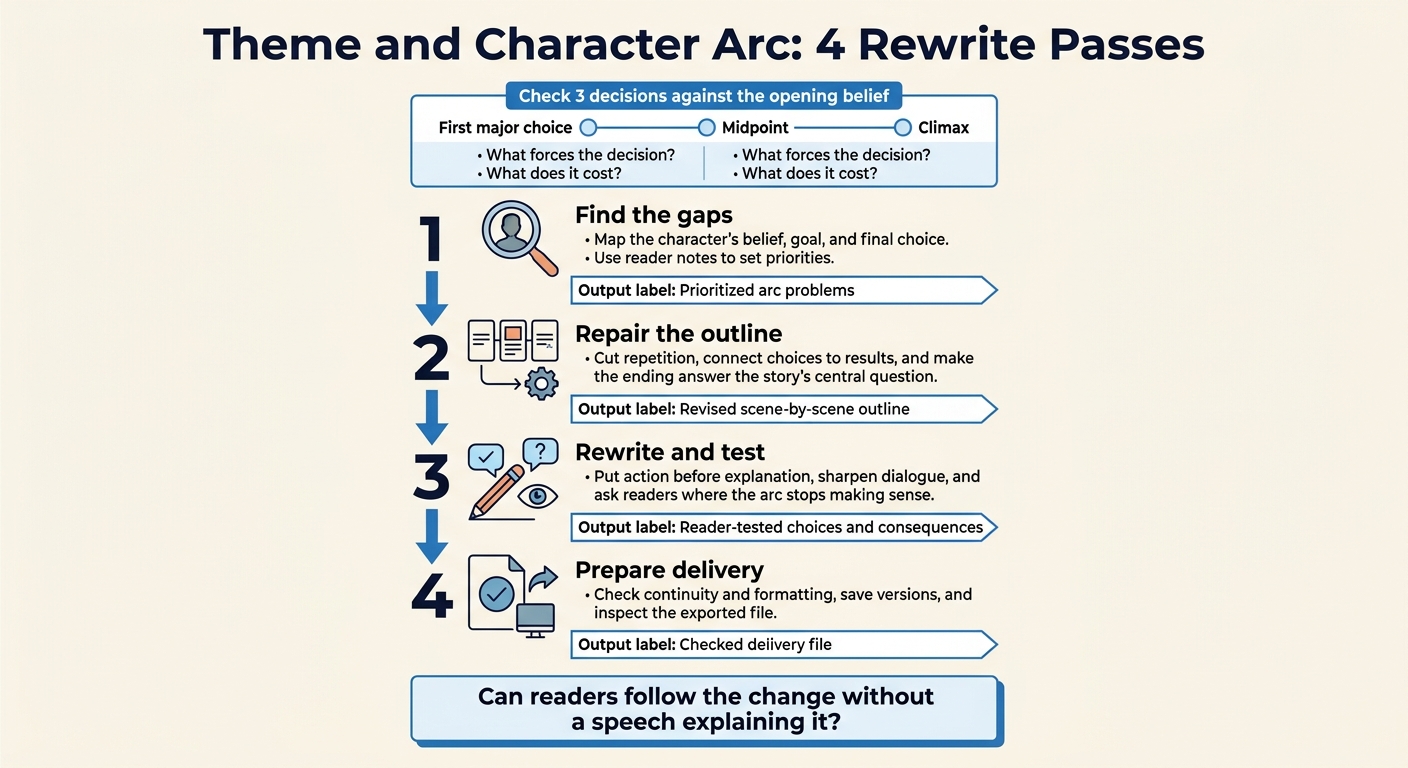
I fix theme problems by rewriting choices - not adding speeches. My first check is simple: compare the protagonist’s opening belief with 3 decisions - the first major choice, the midpoint, and the climax. I look for what forces each decision and what it costs.
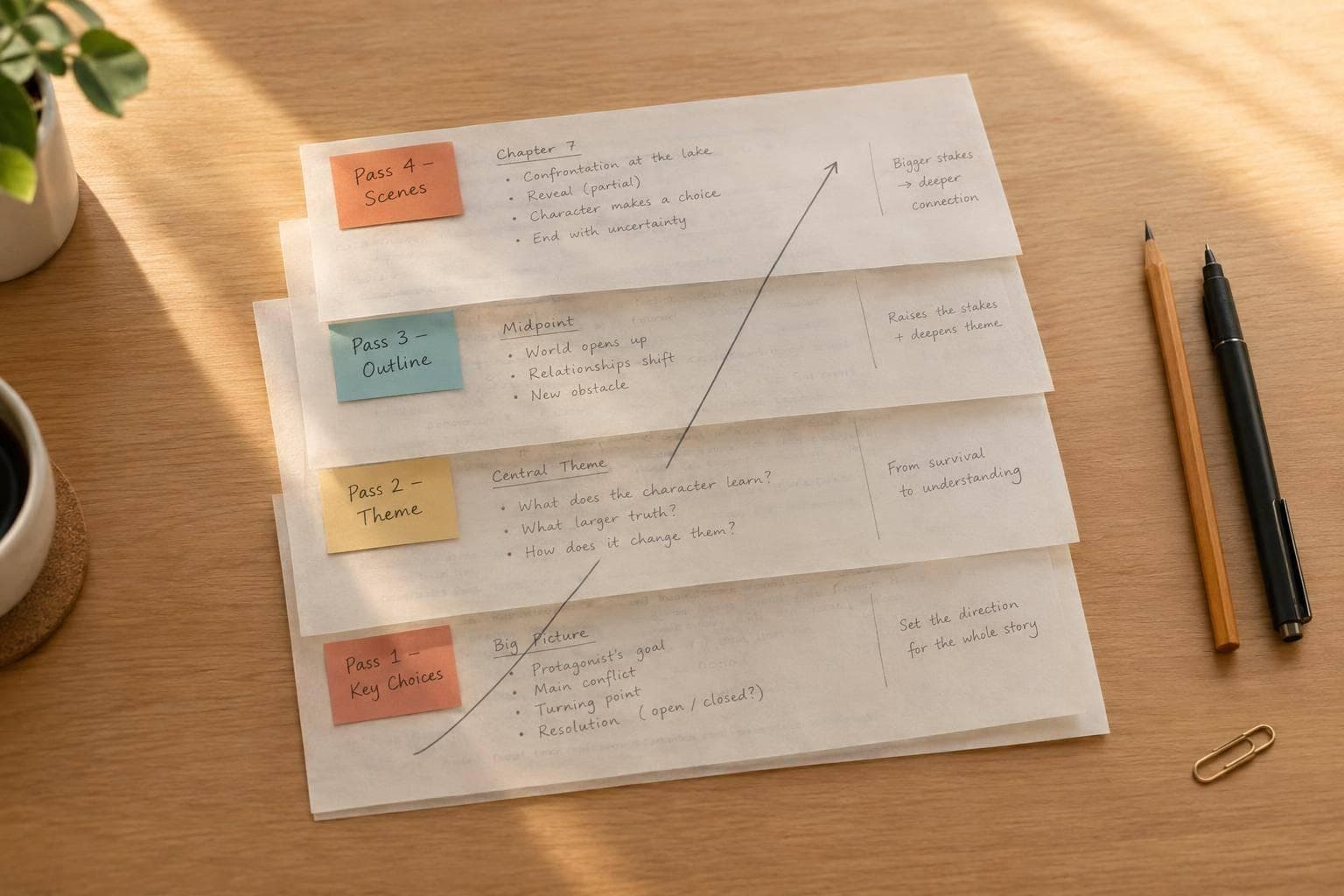
Then I work through four passes:
- Find the gaps: Map the character’s belief, goal, and final choice. Use reader notes to set priorities.
- Repair the outline: Cut repetition, connect choices to results, and make the ending answer the story’s central question.
- Rewrite and test: Put action before explanation, sharpen dialogue, and ask readers where the arc stops making sense.
- Prepare delivery: Check continuity and formatting, save versions, and inspect the exported file.
I adjust the arc’s scope for a short, pilot, or feature and treat AI suggestions as options, not instructions. My final test: <u>Can readers follow the change without a speech explaining it?</u>
Theme and Character Arc: 4 Rewrite Passes
Ep. 433: How to Intertwine Plot, Character, and Theme in Every Scene
sbb-itb-609c31f
Step 1: Find Theme and Character Arc Problems
Use the gap you found in the introduction to pinpoint where belief and action don’t line up. Before editing, save a clean baseline: Project_Title_Draft_01_Baseline.pdf.
Define the Theme and Character Arc
Write the thematic question, the opposing values, and the ending’s answer. Make that answer a position, not just a topic. Then create a one-page arc map covering the starting belief, external goal, internal need, flaw, pressure moments, key choices, consequences, and final belief. Keep the goal concrete and the need internal. They do different jobs.
Identify the arc type. A positive arc replaces a damaging belief. A negative arc reinforces it at a cost. A steadfast arc tests a core belief without replacing it. Note where the draft first shows each arc element.
Compare Beliefs With Actions
Use the table to test whether the opening belief holds up under pressure. Fill it with scene references, not intentions. Check at least three decisions: the first meaningful choice, the midpoint choice, and the climax. Flag unearned shifts, outcomes that accidentally reward the old belief, and dialogue that announces change without showing it. For every belief shift, find the pressure that causes it and the decision that proves it.
| Character | Starting belief | Goal | Key choice | Consequence | Final belief |
|---|---|---|---|---|---|
| Protagonist | Belief driving early behavior | Concrete objective | Decision under greatest pressure | Result or cost | Belief demonstrated by action |
| Mirror character | Similar belief or shared wound | Parallel objective | Different response to similar pressure | Contrasting outcome | Belief reinforced or changed |
| Foil character | Opposing value | Competing objective | Decision challenging the protagonist | Cost of that opposing approach | Belief tested by the outcome |
Once the table shows the mismatch, rank the fixes that matter most.
Set Rewrite Priorities From Reader Notes
Group reader notes under structure, character, scene, dialogue, and formatting. Separate specific problems from recurring patterns and matters of taste. Rank problems by how much they affect motivation, turning points, and the ending.
Use Scriptwood’s coverage view to find repeated confusion. Then ask AI Consultant follow-up questions about where the goal or belief first becomes unclear. Treat its responses as leads, not directives. Turn each priority into one sentence, gather the affected scenes, and test the smallest change that makes the story work.
Step 2: Rebuild the Outline Around Choices
Build a Scene-by-Scene Reverse Outline
Create one row for each existing scene. Record its number, location and time, viewpoint character, immediate goal, obstacle, tactic, decision, turning point, new information, consequence, and the next question it creates. Record what the scene actually does - not what you meant it to do.
Add a belief-under-pressure column that tracks the character’s current belief, the challenge to it, the tactic used to protect it, and the cost. Flag scenes that repeat an earlier result, change nothing, or lack a causal link. Cut, combine, or move them. Keep quiet scenes if they change a relationship, reveal a cost, or set up a later consequence. They don’t need to state the theme.
Once that chain is clear, test the midpoint, crisis, and climax.
Strengthen Turning Points and the Final Choice
At the midpoint, use a new fact, betrayal, victory, or loss to force the protagonist to revise the plan or double down on a flawed belief. Make that strategy more costly. At the crisis, give the protagonist two genuine alternatives, each with a price. Then make the climax an action with consequences - not a speech about change. The chosen action should change the outcome and answer the theme.
For a pilot, label the episode arc separately from the series arc. Resolve the immediate decision and show its cost without completing the character’s entire transformation. Leave a belief, relationship, mystery, or long-term goal unresolved so future episodes can test it.
Compare the Original and Revised Outline
Scene or beat Original purpose and decision Revised purpose and decision Theme pressure Resulting consequence Midpoint: audit meeting Protagonist learns of company cheating; supervisor decides to investigate Protagonist hides proof to protect a promotion Tests the belief that success excuses silence Coworker is blamed; protagonist becomes complicit Crisis: family confrontation Sibling argues with protagonist about work Protagonist chooses disclosure over submitting false records Pits personal loyalty against public responsibility Protagonist loses family support Climax: public hearing Protagonist gives a speech about honesty Protagonist submits evidence despite losing the promotion Makes honesty require sacrifice Scheme exposed; damaged career must be rebuilt
Label each revision keep, combine, cut, move, or rewrite, and explain why in one sentence. Compare motivation, causality, escalation, and outcome. If you move a scene but the same character makes the same decision with the same result, you’ve probably improved only the order - not how the scene serves the arc.
Use the revised outline to guide scene and dialogue rewrites.
Step 3: Rewrite Scenes and Dialogue, Then Get Feedback
With the outline fixed, check whether the arc holds up in scenes and dialogue.
Test Character Beliefs Through Action
Complete the action pass first. Show the theme through what characters do, not what they explain. Check every scene choice against the revised outline.
For each important scene, identify the character’s want, the pressure they face, their choice, and its consequence. Then look for later behavior that shows the consequence has stuck. Replace internal explanations with actions readers can see. Trim setup or aftermath that adds no new pressure.
Give recurring objects or routines a role in the plot. As the character’s belief shifts, change how they use them.
Use Subtext Instead of Theme Speeches
Read exchanges aloud to catch repetition, flat rhythm, and voices that sound alike. Pin down what each speaker wants but can’t say directly, and how that pressure tests their belief. Let omissions, evasions, physical behavior, and changes in tactics carry the tension. Keep each character’s vocabulary and sentence patterns intact.
Keep direct thematic lines only when they force a choice or shift power.
Use Scriptwood’s scene and dialogue rewrites to test alternatives - not to replace scenes automatically. Enter the character’s goal, obstacle, belief, and tactic, along with plot needs and continuity limits.
Save the original, then compare options for motivation, voice, connection to the theme, and continuity. Reject smoother dialogue if it makes the character too articulate, changes the intended power dynamic, or cuts a needed thematic statement.
Once the scene works on the page, share it with readers.
Check the Revised Arc With Readers
After both passes, share a clearly labeled draft. Ask readers where motivation breaks down, which choices feel earned or forced, where the protagonist first questions the old belief, which scene tests their resolve, and what the ending suggests they now believe.
Ask for scene numbers or specific lines before explaining your intent. That first read is the test.
Separate execution problems from personal preferences. Use Scriptwood’s draft history to compare versions for arc consistency. Tie feedback to the relevant passages, record why you accepted or rejected major changes, and check that each revised choice still supports later behavior.
Step 4: Prepare the Draft for Delivery
Once the story arc reads clearly, get the draft ready to send.
Read the Draft and Check Formatting
Read the draft once without editing. Approach it as a reader, and keep separate notes on pacing, motivation, continuity, and unclear stakes. Check that the final choice still comes through clearly. Fix story-breaking issues first, continuity next, and sentence-level wording last. Keep rewriting separate from formatting.
Check scene headings for INT./EXT., location, and time. Confirm that action uses present tense, cues sit in the right place, dialogue indents stay consistent, and page breaks keep cues attached to dialogue. Review US English spelling and punctuation. Remove duplicate scenes, alternate endings, unresolved comments, and private notes. Search for TODO, TK, and TEMP, checking each match manually. Make sure the title page meets the recipient’s requirements.
After the readthrough, move straight to export checks.
Save, Export, and Check the File
Treat export as the last quality check. Keep the working file, approved master, and delivery export separate. Name the delivery draft with the project, version, date, and status - not “latest.” Save earlier versions. Send any story changes back for review, and leave the approved master untouched during export.
Confirm the recipient’s requirements, then use Scriptwood to export the requested PDF or editable screenplay format. For reading submissions, send a PDF unless instructed otherwise. Send an editable file when the recipient needs to keep working on it.
Open the exported file, not just the source. Compare its title page, first and last pages, page count, headings, dialogue, and page breaks against the approved master. Check quotation marks, em dashes, accented names, missing text, and blank pages.
For editable files, test the file in the receiving application. Record the filename, export date, format, page count, and reviewer before attaching it.
Conclusion: Let Choices Carry the Theme
After your rewrite passes, use the ending as the final test of theme. Start with the thematic question. Then follow the protagonist’s arc from opening belief to final choice, tracking the pressure and consequences along the way. Ask readers to check that arc, and review the export only after the story works.
Would the theme still come through if you cut every thematic speech? The protagonist’s choices and their results should carry it. If they don’t, strengthen the choices, the cost, or the outcome. Explanation can’t replace a clear decision on the page.
FAQs
How can I tell if my theme or character arc needs fixing?
Check whether the protagonist ends the script with the same fear, belief, or worldview - and never makes a meaningful internal choice that challenges it. Pinpoint their “blocked belief”: the fear or internal obstacle holding them back. Then ask whether the climax forces them to face it.
Watch for motivation shifts that lack clear, earned triggers, too. Scriptwood’s AI Coverage can help flag character-arc gaps, logic inconsistencies, and drifting motivations.
How do I strengthen an arc without changing the plot?
Focus on what’s holding the character back inside, not on external events. Pinpoint the belief, wound, or fear that blocks their growth, and make the climax force them to face it.
You don’t need to move scenes or change the plot. Instead, deepen the character’s emotional responses to what already happens. Make sure earlier scenes lay the groundwork for that inner change, so their choices and shifts feel earned.
How much character change can a short film support?
Short films can give characters just as much room to develop and change as features and pilots. The four-pass rewrite process works for shorts, too: start with structure and character arcs, then tackle pacing, then dialogue.
For an arc to work, the protagonist needs a clear internal obstacle or belief that gets challenged at the climax. If the arc stays flat or the change feels unearned, return to the structure. That’s where you build the groundwork for the protagonist’s emotional shift.