
Co-Writing with Friends: Handling Disagreements

Co-Writing with Friends: Handling Disagreements
Most friend writing teams don’t get stuck because of the script. They get stuck because the process is loose.
If I want to finish a script with a friend without hurting the friendship, I need to lock down 4 things early: how we give notes, who owns which calls, how we handle deadlines, and what we do when we hit a tie. That matters because missed handoffs, vague feedback, and fuzzy control often turn small script issues into personal fights.
Here’s the short version:
- Keep notes tied to the page. Comment on the scene, line, or beat.
- Split ownership. One person should have final say in each area.
- Use small deadlines. Weekly handoffs work better than loose due dates.
- Set a backup plan. If someone is late by 48 hours, decide what happens next.
- Protect the friendship with rules. Use simple checks like story movement and character arc.
A simple process can cut a lot of stress. In team projects, role clarity can lift output by 25%, and clear short-term goals can improve follow-through by about 20% to 25%. The point is simple: less guesswork, less friction.
If I set the rules before the first bad note or missed draft, I give both the script and the friendship a better shot.
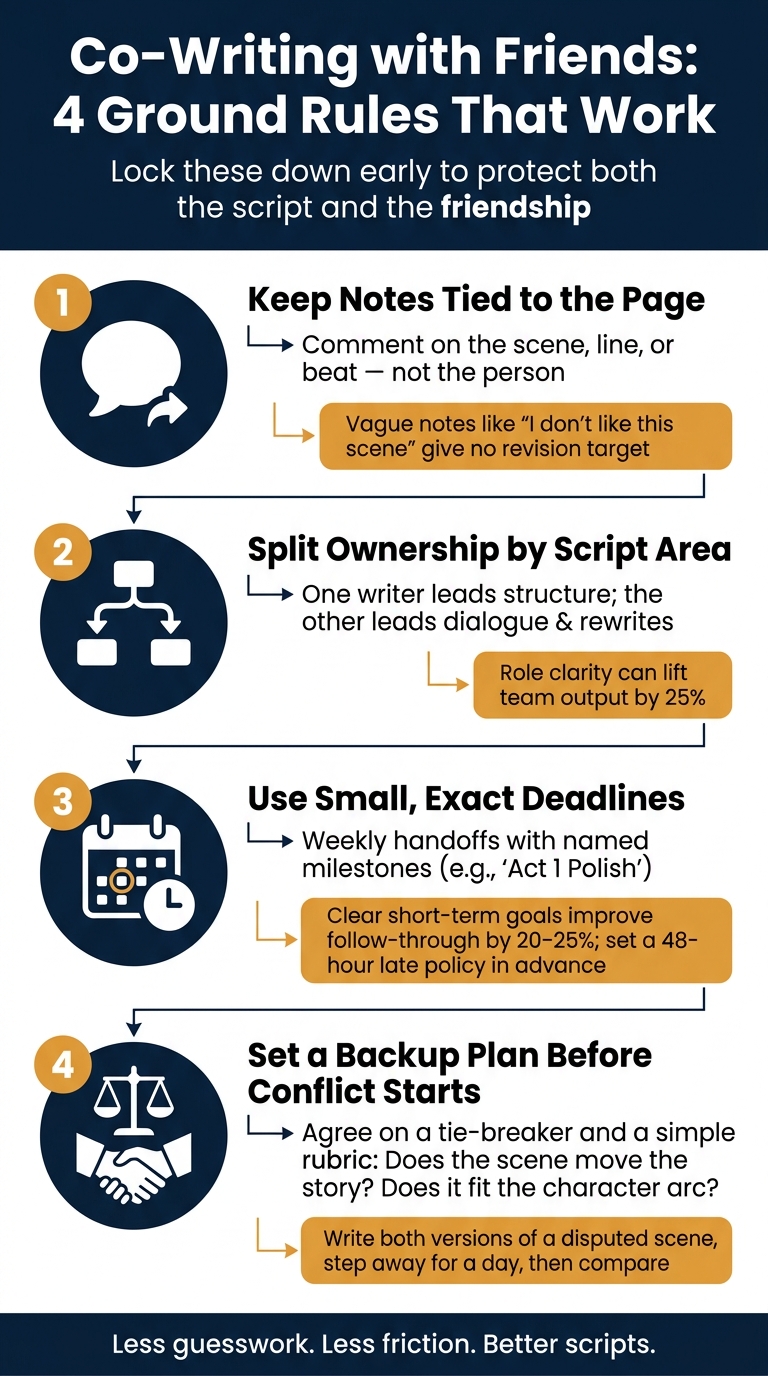
Co-Writing with Friends: 4 Ground Rules to Protect Your Script and Friendship
How to Collaborate to Resolve Conflict
sbb-itb-609c31f
Problem 1: Feedback Tone Turns Notes Into Personal Conflict
In friend partnerships, the first real clash usually starts with how notes are given. A comment that should stay on the page can suddenly sound like a judgment on the person. And when both writers already know each other’s sore spots, that shift happens fast. Once feedback feels personal, the draft tends to freeze.
Focus feedback on the page, not the person
The fix is specific notes, not just nicer phrasing. "'I don't like this scene' gives no revision target." It leaves the other writer guessing: Is the problem the dialogue, the pacing, the emotional beat, or something else?
A stronger note points to the exact scene or line and explains what it’s doing to the script. Maybe the scene slows the pace. Maybe a line weakens the character’s motive. That kind of feedback gives the writer something they can work with. More to the point, it keeps the discussion tied to the draft instead of drifting into personal territory.
Set a repeatable notes process before the next draft
The way you handle notes matters just as much as the words themselves. Pick a process before the next round starts. You might give notes live during a session, in writing before you meet, or use both.
What matters is consistency. When notes sit inside the document - attached to the exact scene or line they refer to - disagreements stay concrete. You’re talking about this beat, this exchange, this page. Not arguing in broad, fuzzy terms that go nowhere.
A shared workspace helps with that. Scriptwood’s inline comments and draft history keep feedback linked to the scene and make earlier versions easy to revisit. That backup makes it easier to keep notes about the script, not the relationship.
Once feedback stays objective, the next risk is unclear ownership.
Problem 2: Blurred Roles Lead to Rewrites and Power Struggles
When two friends write a script together, it’s easy for both people to drift into every part of the work: structure, dialogue, line edits, and rewrite calls. That sounds fine at first. In practice, it often leads to double rewrites, mixed signals, and no clear final say. The draft slows down because both writers are steering the same scene at the same time.
Divide responsibilities by strength and script area
The simplest fix is to split ownership by part of the script. One writer can take the lead on structure: act breaks, scene order, and the main spine of the story. The other can own dialogue polish and rewrite passes. You can also divide scene ownership, so each writer has final edit control over certain sections after both people talk them through.
Both writers should still be free to comment across the script. But for each assigned section, one person makes the final call. That cuts down on back-and-forth and keeps the draft moving. Scriptwood lets you set collaborator permissions - view, comment, or edit - so ownership is clear instead of left to guesswork.
Write down decision rules before conflict starts
Put the rules on paper before there’s any friction. A one-page agreement is often enough. Spell out who owns which pages, who approves final wording, and how deadlocks get settled.
That last part is the one many co-writers skip, and it tends to cause the most trouble. If you pick a tie-breaker ahead of time, you don’t have to invent a process in the middle of an argument. Scriptwood's AI coverage reports can also help when you split on a structural call by giving both writers an objective read on structure, pacing, and character development.
Clear rules stop rewrites from turning into power struggles. The next problem is missed deadlines.
Problem 3: Missed Deadlines Build Resentment and Stall the Draft
In screenwriting, scenes lean on each other. So when one scene is late, the next one can’t move. That puts both writers in a bad spot. One person has to wait, or one person has to do extra work. Either way, frustration shows up fast.
Set smaller milestones and make progress visible
The answer isn’t harsher deadlines. It’s smaller, clearer checkpoints.
Split the draft into weekly handoffs and named milestones like "Act 1 Polish" or "Scene 5 Revision." That way, delays show up early instead of sneaking up on you. And use exact dates like Oct. 6 instead of loose timing like “end of week.” Clear dates leave less room for mixed signals.
Scriptwood’s named draft saves and draft history make this easier to track. You can see when a section has stopped moving instead of guessing.
Agree in advance on what happens when someone falls behind
This is the part many co-writers avoid. Don’t wait until someone misses a deadline and tensions are already high.
Before drafting starts, set a reset plan. If a deadline slips by 48 hours, decide what happens next. Maybe the other writer takes over the scene. Maybe both of you roll back to the last approved version. If a rewrite starts drifting off course, trim the scope or hand the scene to the other person instead of arguing about it in the moment.
Scriptwood’s real-time collaboration and draft history help with that kind of handoff. Both writers can see the latest changes and jump in without losing earlier work.
Even if the handoffs are smooth, there’s still another challenge waiting: keeping the friendship steady when the notes get sharper.
Problem 4: Keeping the Friendship Intact While Moving the Script Forward
Conflict in writing rarely stays on the page. It changes how feedback sounds, makes simple notes feel loaded, and can put real pressure on the friendship. Putting off a hard talk may feel easier in the moment, but it also slows the script. The point is to fix the note, not treat the disagreement like a judgment on the friendship.
Have hard conversations early and use objective criteria
Bring up problems while they're still small. A note about the pacing of one scene is workable. That same issue, ignored for three drafts, can start to feel personal.
When you raise a concern, keep it tied to the script, not to each other. Set a simple rubric before you start drafting. For example:
- Does the scene move the story?
- Does it fit the character arc?
That kind of shared standard keeps the talk grounded. If the rubric still doesn't settle the issue, put both versions next to each other and compare them on the page.
If you hit a wall on a scene, write both versions. Then step away for a day and come back with fresher eyes. Review them together and use draft history so neither writer loses their work.
For bigger disagreements - structure, motivation, or the main story direction - use coverage so you're reacting to the same read instead of arguing from memory.
Conclusion: Ground Rules That Protect Both the Script and the Friendship
Across feedback, roles, deadlines, and decision-making, the same idea keeps showing up: most co-writing problems between friends aren't creative problems, they're process problems. Notes can feel personal. Roles can stay fuzzy. Deadlines can slip. All of that gets much easier to fix when you deal with it early and agree on how you'll handle it.
Keep notes specific and tied to the page. Define who owns which calls. Use exact dates for milestones. If something feels off, say it early and back it up with shared criteria. Tone, roles, deadlines, and decision rules help protect both the script and the friendship. The friend writing teams that make it through are usually the ones that set clear rules before things get messy.
FAQs
How do we split final say fairly?
Set a clear decision-making framework before the writing starts. Give each section a lead writer, or choose one partner as the final call on creative disagreements so you don't get stuck in a stalemate.
If you reach an impasse, Scriptwood can provide objective coverage analysis to help guide the call. Its draft history also lets you try both directions and roll back if needed.
What if one writer keeps missing deadlines?
Address it early with open, calm communication. The goal is simple: figure out whether the issue is personal or tied to the project scope. From there, reset clear shared expectations for deadlines and deliverables so everyone knows what needs to happen next.
If the partnership still feels strained, Scriptwood can help smooth out the workflow. Its real-time collaboration and draft history make progress easier to track, which helps protect both the working relationship and the script’s momentum.
How do we disagree without hurting the friendship?
Keep feedback specific and respectful. Talk about scenes, structure, and craft, not personal taste. And always explain why. That small step changes the whole conversation. Instead of “I just don’t like this,” you get “this scene slows the pace” or “this turn doesn’t feel earned yet.” That kind of note gives the other person something they can actually work with.
Set boundaries early about who decides what and when. If that sounds a little stiff, it’s not. It’s what keeps a good working friendship from drifting into tension. You don’t want to hit a deadline and suddenly realize no one knows who has final say on the ending, the rewrite, or the last pass.
If deadlines slip, do a quick reset of priorities instead of arguing. Pause, look at what still matters most, and decide what gets done first. A short reset can save hours of frustration.
It also helps to agree on a process for handling disputes before you need it. Maybe one person has final say in some areas, or maybe you bring in a third reader when you hit a wall. The point is simple: protect both the friendship and the script.