
7 Dialogue Realism Checks For Screenplays

7 Dialogue Realism Checks For Screenplays
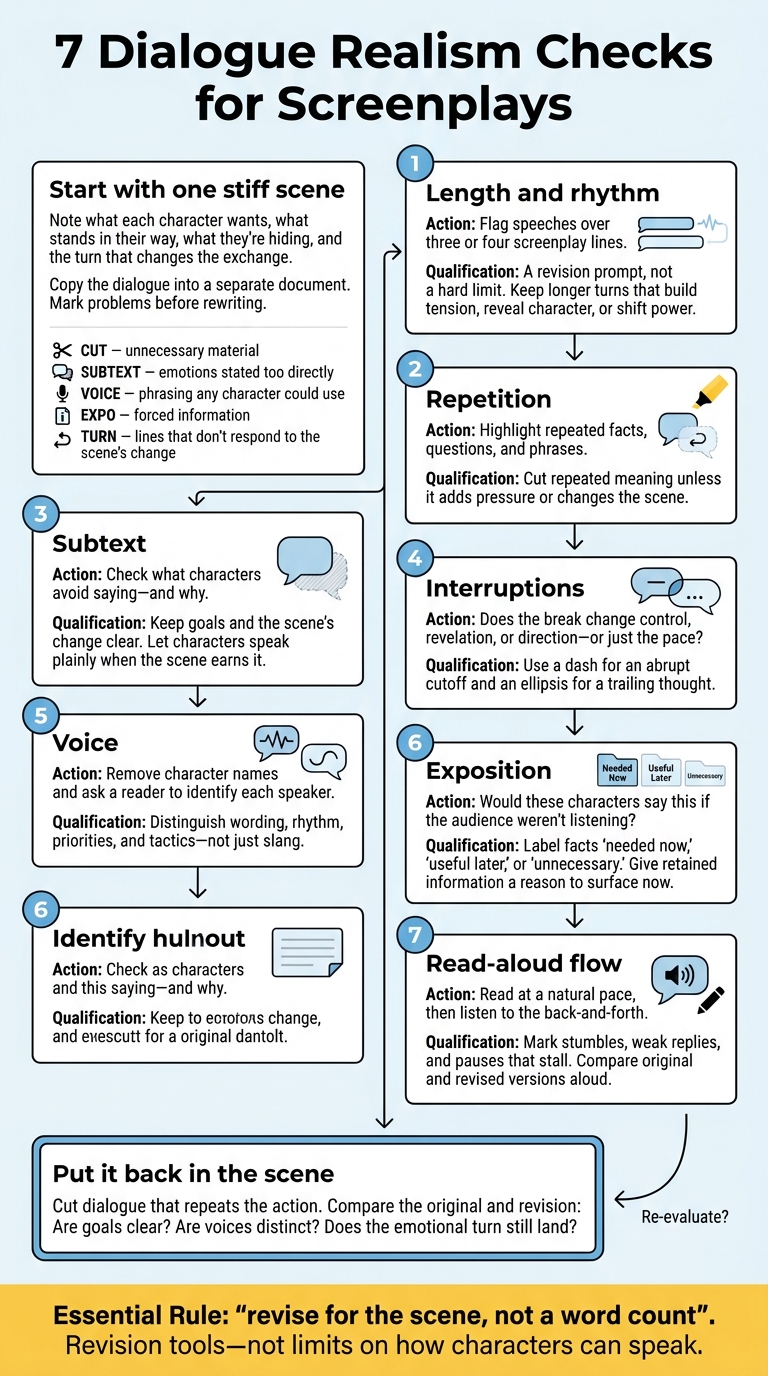
I check dialogue by asking what each line does - not whether it sounds like everyday conversation. Start with one stiff scene: note what each character wants, what they’re hiding, and where the exchange changes.
Then I run these 7 checks:
- Length and rhythm: Flag speeches over three or four screenplay lines, but keep longer turns that serve the moment.
- Repetition: Cut repeated ideas unless they add pressure or change the meaning.
- Subtext: Check what characters avoid saying - and when they would speak plainly.
- Interruptions: Make cutoffs and unfinished thoughts affect the exchange.
- Voice: Give each speaker their own wording, rhythm, and way of getting what they want.
- Exposition: Keep information characters have a reason to share now.
- Read-aloud flow: Listen for awkward phrasing, weak replies, and pauses that stall the scene.
My rule: <u>revise for the scene, not a word count</u>. I compare the original and revised versions to see whether the characters’ goals stay clear and the emotional turn still lands. These are revision tools, not limits on how characters can speak.
7 Dialogue Realism Checks for Screenplays
Write better dialogue in 8 minutes.
sbb-itb-609c31f
Set Up a Dialogue-Only Revision Pass
Choose one stiff scene from your draft. Before changing any lines, note what each character wants, what stands in their way, and what they’re hiding. Then pinpoint the turn that changes the exchange. Use those notes to judge whether the dialogue moves the scene forward.
Copy the dialogue into a separate document.
Mark problems before rewriting. Use short labels: CUT for unnecessary material, SUBTEXT for lines that state emotions too directly, VOICE for phrasing any character could use, EXPO for forced information, and TURN for lines that don’t respond to the scene’s change. Find what’s wrong before polishing lines the scene may no longer need. Then check whether interruptions and unfinished thoughts sound natural.
Put the dialogue back into the full scene and cut any line that repeats what the action already shows. Check that each speaker responds to what just happened and that the turn still lands.
Match each character’s speech to their background, setting, age, profession, and community. Use slang, dialect, code-switching, and regional vocabulary with purpose, and keep them readable and consistent. With the scene isolated, start with line length and rhythm.
1. Check Line Length and Rhythm
Test the isolated scene’s pace: flag speeches longer than three or four screenplay lines. Treat this as a revision prompt, not a hard limit. A confession, an attempt to persuade, or a deliberate monologue may need that space. But several equally long, polished replies can make an exchange feel written rather than lived.
Label each speech short, medium, or long, then look for stretches where every turn runs the same length. Short exchanges can build speed and tension. Longer turns can show someone controlling the conversation. Neither should be the scene’s only rhythm.
For each flagged speech, ask what changes while the character speaks - and why the listener lets them continue. Mark where explaining turns into accusing, or denying turns into pleading. Add a listener’s response only if it changes the exchange.
Match length to the scene’s pressure, not a word count. After a major revelation, a brief reply - or silence - may carry more weight than another explanation. Keep a long speech when it builds tension, reveals character, or shifts power.
2. Check for Unneeded Repetition
Once the line rhythm feels right, cut ideas that land twice. Highlight repeated facts, questions, and phrases, including anything the audience already learned through action or an earlier scene. Repetition is about meaning, not matching words. Even a recap in different words can slow the exchange.
Identify what each line does: delivers information, adds conflict, reveals character, conveys subtext, adds humor, sets the pace, or escalates tension. Temporarily cut any line that only confirms the previous point. If the scene remains clear and its emotional turn still lands, leave it out.
Keep repetition that denies, mocks, pressures, or avoids. A recurring phrase can show a character’s fixation; an echoed accusation can express disbelief. What matters is whether the repetition changes the scene, not whether the same words appear twice.
When needed information returns, give it another job. Add a consequence, contradict the earlier claim, or shift control of the exchange. Changing the wording alone still leaves the same redundant beat.
3. Check Subtext and Direct Emotion
After cutting repetition, check whether the remaining lines still say too much. Mark lines that name feelings, explain motives, or spell out the scene’s meaning. Would the character admit that openly right now? Subtext is what a character means but avoids saying directly - not a rule to hide every feeling.
Before revising, pin down why each character holds back: pride, shame, fear, politeness, or uncertainty. Then choose a topic they can use to dodge the truth. Without a reason to hold back, evasive dialogue can feel forced.
When a line names the emotion outright, try cutting it. Replace it with a deflection, a practical task, or an action that contradicts the character’s words.
But hidden emotion shouldn’t make the scene hard to follow. Readers still need to understand what each character wants and what changes during the exchange, even if the feeling behind that shift goes unspoken. If either gets lost, bring back a direct line or make the action clearer. Don’t make the dialogue more cryptic.
Let characters speak bluntly when the scene earns it: during a confrontation, an admission they can’t take back, or a moment when they finally drop their guard.
4. Check Interruptions and Unfinished Thoughts
When characters dodge the truth, interruptions can add pressure. Mark every cutoff, ellipsis, sentence fragment, and broken line. Then ask: Does the break change control, revelation, or direction - or just the pace?
For each interruption, identify what the speaker can’t finish saying and what the other character gains. Track who cuts in and who yields. If one character usually backs down, a single refusal can signal a power shift.
Use a dash for an abrupt cutoff and an ellipsis for a trailing thought. Keep this notation consistent. Use an “interrupting” parenthetical only when the timing is unclear.
For unfinished thoughts, write out the missing words. Does the other character’s response make that unspoken meaning clear? Read the scene again with every thought completed. If nothing changes, restore the sentence or cut the pause.
Watch for breaks that repeat the same timing or serve the same purpose. Let some thoughts finish. Use action or sound when either fits the break better than another voice. Once the timing and interruption patterns feel natural, check that each speaker still sounds like themselves.
5. Check Each Character’s Voice
Using your voice notes, copy a page of dialogue and remove the character names. Ask a reader to identify each speaker by their wording, rhythm, and tactics. Mark the places where the voices blur together.
For each major speaker, note what they want, what they’re afraid to reveal, and how they usually get their way. Compare their vocabulary, sentence length, humor, and directness. If everyone explains, jokes, or argues the same way, change how they approach the conversation.
Look at what each person notices, hides, or avoids. Then remove the slang. If the voice falls flat, sharpen the character’s priorities and the ways they protect themselves. Skip phonetic accent spellings; use readable syntax, vocabulary, and accurate idioms instead.
Test the same character across different relationships and moods. They can sound guarded, formal, or hesitant and still sound like themselves. Even clearly different voices can fall flat when a line states its point too directly.
6. Check for Forced Exposition
After checking voice, look for lines that exist only to brief the audience. Would these characters say this if the audience weren’t listening? Flag dialogue that awkwardly recaps shared history, explains procedures the characters already know, or describes what the scene shows. Those lines serve the writer’s need to explain - not the character’s goal.
Label each fact needed now, useful later, or unnecessary. Keep only what the audience needs to follow the current conflict, decision, or risk. Temporarily remove everything else, then see whether the scene still works.
For information that must stay, give the speaker a reason to reveal it now. They might need to secure agreement, challenge a lie, or force a decision. Let the listener push back, interrupt, or resist. Direct explanation works only when the listener needs the answer and that answer changes the scene.
Place background details where they affect a choice. If a fact doesn’t change the scene now, cut it or move it.
7. Read Dialogue Aloud to Check Flow
Use this final pass to hear whether the lines that passed earlier checks still work aloud. Read the scene once at a natural pace. Mark every word where you stumble, rush, or lose emphasis. A line can read well on the page and still be hard to say.
Read it again, this time listening to the back-and-forth rather than each line on its own. Watch for replies that don’t connect, stretches where the energy drops, and pauses that stall the moment instead of adding depth. Some scenes need breathing room. Don’t rush grief or uncertainty.
Ask someone else to read one role. Explain the scene’s objective and tone, then note where they need clarification, put emphasis in the wrong place, or instinctively rephrase a line. Treat those reactions as rewrite signals, not rules.
Where delivery stumbles, try shorter phrasing, contractions, or a different word order. Read the original and revised versions back-to-back, and keep the one that best serves the scene’s intent. If a changed line shifts the rhythm, reread the whole exchange before moving on.
Conclusion: Revise One Scene at a Time
For a final realism check, choose one scene with a clear objective, conflict, and emotional turn. Save the original, then run all seven checks to see how they work together. Use this trial before changing dialogue throughout your feature or pilot.
Cut for dramatic purpose, not word count. Keep repetition or interruptions only when they change the scene. Realism comes from motivation, not clutter.
After the second pass, compare the two versions. Do the characters still want different things? Do they sound distinct? Does the scene’s emotional turn still land?
Scriptwood can help with screenplay editing, AI dialogue rewrites, draft history, and collaboration tools.
If the revised scene is clearer, more grounded, and stronger when read aloud, apply what worked to similar scenes.
FAQs
How can I tell if stiff dialogue reflects a deeper scene problem?
Before rewriting dialogue, check whether the scene moves the story forward or changes the stakes. Scenes often stall when they lean on exposition or repeat what the audience already knows. Sharper dialogue won’t fix that. Scriptwood’s AI coverage can help flag these structural issues.
If the structure works, look at character motivation. Emotional reactions that haven’t been earned or backstory spelled out in dialogue may call for deeper character development - or more visual storytelling.
How do I balance subtext with clarity?
Trust your audience. Let actions, tone, word choice, and reactions carry the meaning instead of having characters spell out their feelings or the scene’s themes. If a scene needs more weight, try cutting 10% to 15% of the dialogue. See whether the action can do the work.
Read the scene aloud. If a line can go without losing the narrative point, cut it and give the subtext room to breathe.
How can I make dialogue natural without losing my style?
Save dialogue polish for later, once your structure, character arcs, motivations, and stakes are solid. Read your script aloud to spot stiff rhythms. Can readers tell who’s speaking without character labels?
Swap on-the-nose explanations for subtext, actions, or contradictions. When tightening a scene, aim to cut 10% to 15% of the dialogue. Trust actors to convey meaning through silence, and check that each edit fits the character’s voice and the story’s tone.