
AI Script Coverage vs Human Logic Notes
AI Script Coverage vs Human Logic Notes
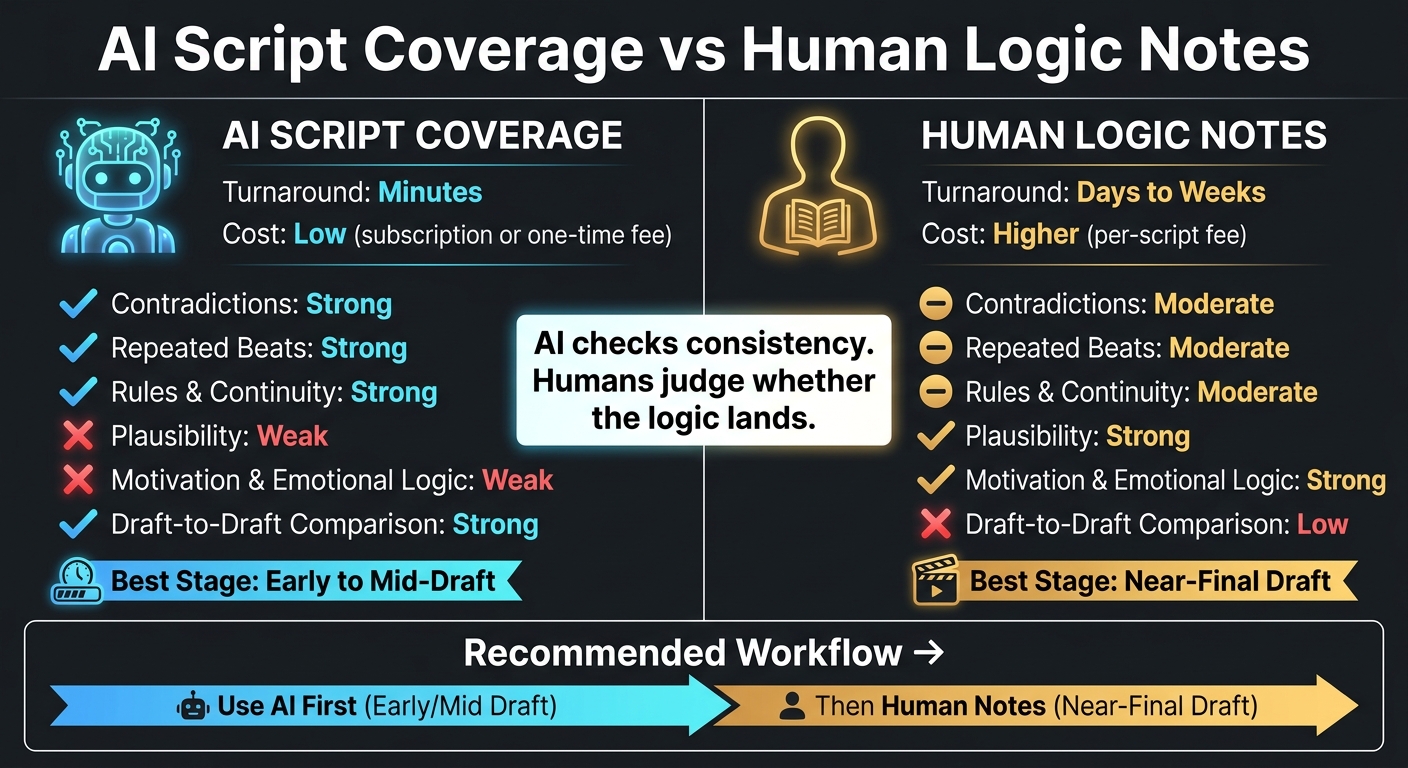
If I want fast logic cleanup, I’d use AI first. If I need to know whether the story feels right, I’d use a human reader.
Here’s the short version:
- AI script coverage is best for finding page-level logic issues like continuity slips, repeated beats, rule breaks, and draft-to-draft changes.
- Human logic notes are better for judging plausibility, character motivation, emotional logic, and genre payoff.
- AI is faster and cheaper. The article puts AI turnaround at minutes, while human notes can take days to weeks.
- Human notes are better near the finish line. That’s when I need feedback on whether a scene feels earned, not just whether it matches earlier setup.
- Best workflow: use AI in early and mid-draft stages, then use human notes on a near-final draft.
A simple way to think about it: AI checks consistency. Humans judge whether the logic lands with a reader.
Quick Comparison
| Criteria | AI Script Coverage | Human Logic Notes |
|---|---|---|
| Turnaround | Minutes | Days to weeks |
| Cost | Lower, often subscription or one-time fee | Higher, per-script fee |
| Contradictions | Strong | Medium |
| Repeated beats | Strong | Medium |
| Rules and continuity | Strong | Medium |
| Plausibility | Weak | Strong |
| Motivation and emotional logic | Weak | Strong |
| Draft comparison | Strong | Low |
| Best stage | Early to mid-draft | Near-final draft |
The main point is simple: these two tools do different jobs, so I’d use them at different stages instead of treating them as substitutes.
AI Script Coverage vs Human Logic Notes: Side-by-Side Comparison
Vetting Your Screenplay: Human or AI Feedback?
sbb-itb-609c31f
How AI Script Coverage Handles Logic and Consistency
AI coverage reads the script as a whole. It scans for logic issues across structure, characters, pacing, and dialogue. That makes it useful for logic checks because it can surface issues a writer may want to revisit.
What AI Catches Well: Continuity Slips, Repeated Beats, and Rule Breaks
AI does its best work on continuity slips, repeated beats, and rule breaks. An automated pass can surface those issues in minutes.
That kind of speed is handy. It can spot the same character detail changing from one scene to the next, notice when a beat lands twice, or flag a moment that breaks the story’s own rules.
Those are the kinds of issues AI can surface fast; the harder question is whether the note reflects real story logic.
Where AI Logic Notes Fall Short
This is where things get tricky. The gap shows up most when a scene is intentional but still reads as off.
AI struggles when logic depends on context, tone, or subtext. Plausibility is not the same as internal consistency, and a beat can be technically consistent and still feel unearned. AI flags pattern breaks; it does not judge story intent.
Put simply, AI can tell you that something looks odd on the page. It can’t always tell whether that oddness is a problem, a setup, or a choice.
AI output can be inaccurate, incomplete, or inconsistent, so it should be treated as a first pass.
Where Scriptwood Fits in an AI Logic Pass
Once AI flags a possible issue, the next step is trying the fix without losing the thread of the draft. Scriptwood keeps coverage, editing, AI rewrites, and draft history in one workspace, which makes it easier to test logic fixes in context.
How Human Readers Handle Logic Notes
Human readers are better at filling in the gap between what technically works and what actually feels right. That’s where they still have a clear edge, especially when the problem isn’t a flat-out contradiction, but whether the story has earned what it’s asking the audience to believe.
What Human Readers Catch Better: Plausibility, Motivation, and Context
Human readers are good at judging plausibility, motivation, and emotional logic. A character might make a sudden choice that lines up with earlier scenes on paper, but still feel off. A person reading the script can spot when the motivation isn’t built up enough, when a reveal comes too easily, or when a plot shortcut is dressed up as a character decision.
Take a thriller that solves its third-act tension with a coincidence. The script may stay internally consistent. No rules are broken. But a reader who knows the genre will often mark that moment as unearned. That kind of call depends on knowing what the genre promises and whether the script pays that off.
Human readers also catch breaks in emotional logic. They notice when a character’s grief, anger, or loyalty shifts in a way that doesn’t feel psychologically believable, even if the timeline is clean. That difference stands out even more in the side-by-side comparison below.
Why Human Notes Vary from Reader to Reader
The tradeoff is variation. Human notes are shaped by taste and by how well the reader knows the genre. One reader may label a compressed backstory a plot hole. Another may see it as normal shorthand for that kind of story.
That’s why the same scene can pull different notes from different readers. Feedback helps, but it isn’t a final ruling. And when two readers disagree, the writer has to decide which reaction is closer to how the target audience will read the scene.
AI Script Coverage vs. Human Logic Notes: Side-by-Side Differences
The gap shows up fastest in speed, cost, and the kind of logic each pass can judge.
The easiest way to see it is to put both options next to each other.
Comparison Table: Speed, Cost, Accuracy Type, and Best Use Case
| Criterion | AI Script Coverage | Human Logic Notes |
|---|---|---|
| Turnaround Time | Minutes | Days to weeks |
| Cost | Low - one-time purchase or monthly subscription | Higher - per-script professional fees |
| Contradictions | Strong - catches continuity slips reliably | Moderate - small details can slip through |
| Plausibility | Weak - may be inaccurate, incomplete, subjective, biased, or inconsistent | Strong - judges whether story logic feels earned |
| Repeated beats | Strong - spots structural loops across the script | Moderate |
| Rules and continuity | Strong - tracks established rules within the script | Moderate |
| Draft-to-draft consistency | Strong - draft comparison tools track changes across versions | Low - each reader reviews independently |
| Scalability | High - unlimited coverages available for studios and agencies | Low - limited by reader availability and hours |
| Best use stage | Early to mid-draft | Near-final draft |
The Core Takeaway from the Comparison
AI is faster at checking script-based consistency. Human readers are better at judging whether the logic feels earned. That split matters when you decide what to run first and what to save for final polish.
When to Use Each Review Type and How to Combine Them
The workflow is pretty simple: AI handles draft-stage cleanup first, and human readers handle the final judgment.
Use AI First for Early and Mid-Draft Cleanup
Start with AI before you spend money on human feedback. In early and mid-draft stages, it can flag obvious continuity and structure problems fast. That makes AI the cleanup pass, not the final call.
If you want coverage, revision, and feedback in one place, Scriptwood keeps coverage, editing, and draft history in one workspace. That makes it easier to review AI notes and revise in context.
Use Human Logic Notes for Near-Final Draft Decisions
After the cleanup pass, human readers step in to test whether the script still feels believable to an audience. Once AI coverage clears the obvious issues, human readers tend to add the most value on near-final drafts headed for contests, pitches, or production.
At that point, the job changes. The focus is less about catching slips and more about judging credibility, payoff, and whether the logic feels earned in context. AI output can be inaccurate, incomplete, subjective, biased, or inconsistent, so those judgment calls still need a human pass.
Conclusion: AI and Human Notes Serve Different Stages of the Same Workflow
Use AI to clean up the draft fast, then bring in human readers to judge what still needs to feel earned. Let AI catch continuity slips and rule breaks early, and save human notes for the stage where the draft has to earn belief.
FAQs
Can AI miss real plot holes?
Yes. AI can miss real plot holes.
Scriptwood can scan story elements and structure fast, but its output can still be inaccurate, incomplete, or inconsistent.
It may miss subtle story problems, continuity slips, or deeper logic gaps. That's why human review still matters if you want to check that your script actually holds together.
When should I switch from AI notes to a human reader?
Switch to a human reader when you need professional-grade coverage, legal or clearance advice, or a final read on commercial viability and production readiness.
Scriptwood can quickly flag issues with structure, character, and pacing. But AI can be subjective, and it can get things wrong. When the stakes are high, human judgment matters.
Do I still need human notes after AI coverage?
Yes. Human notes are still worth considering after AI coverage.
Scriptwood can quickly review structure, characters, and pacing. But its output is for informational purposes only and may include errors, omissions, or subjective judgments.
That means the final call is still yours. You should review and verify the notes, especially when you're deciding whether a script is ready for submission, production, or a specific industry workflow.