
How to Write Scene Headings in Screenplays
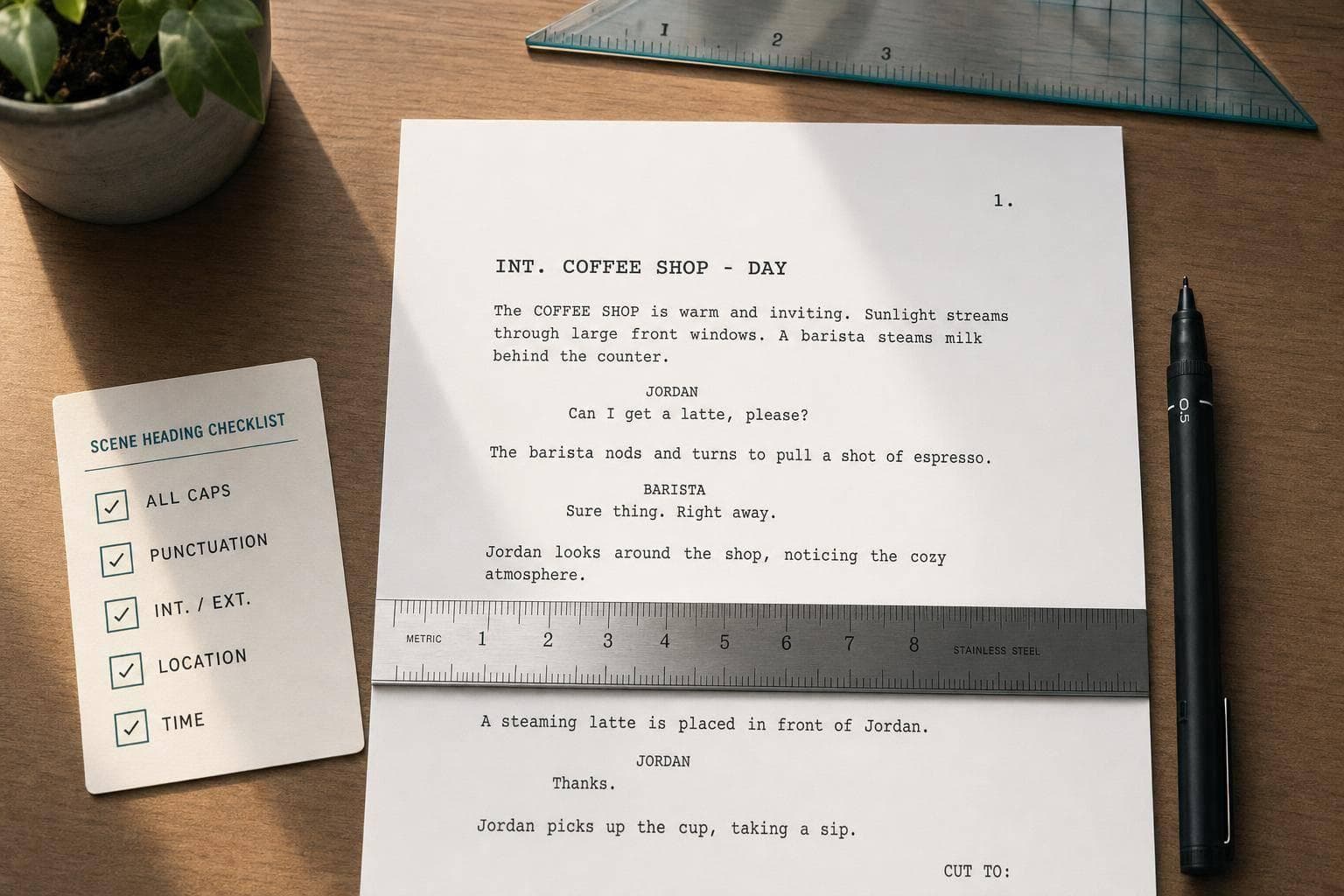
How to Write Scene Headings in Screenplays
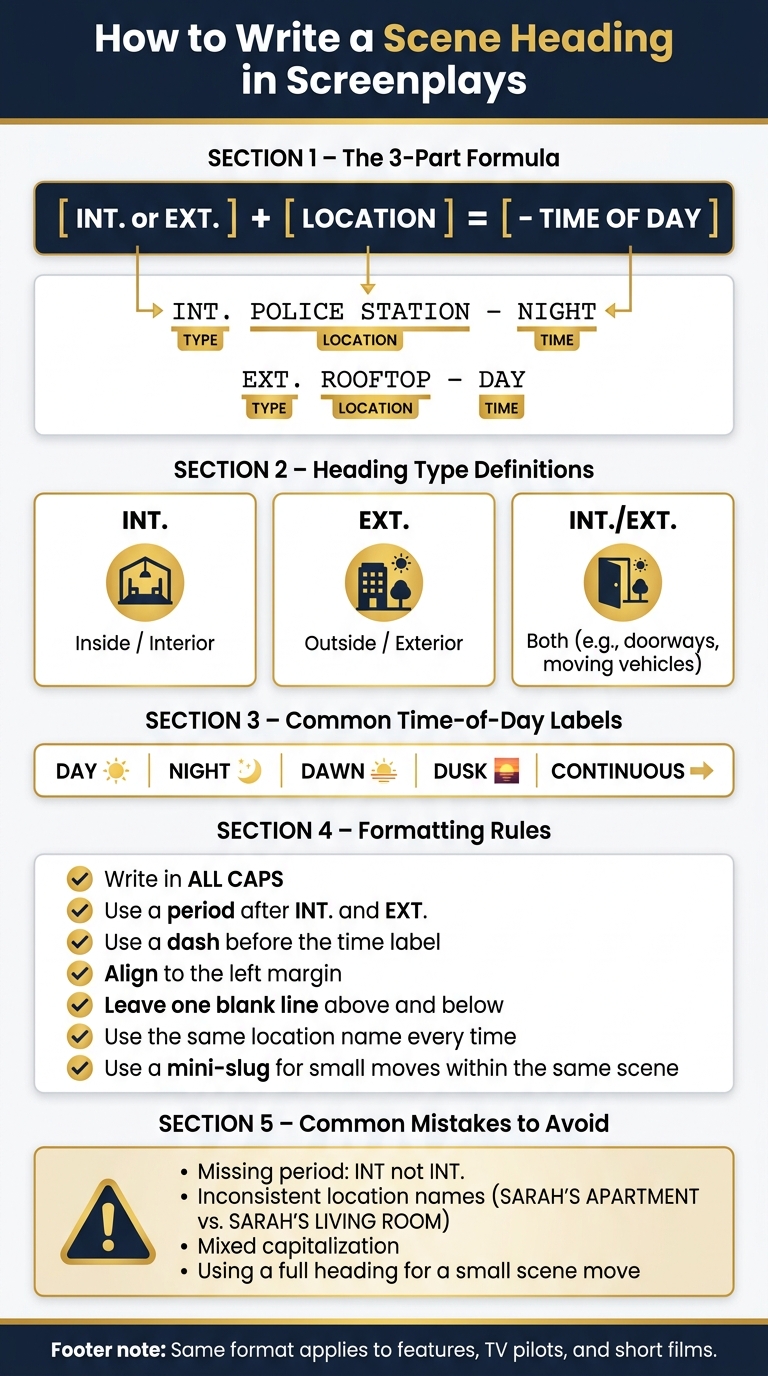
A scene heading has one job: tell me inside or outside, where, and when in a single line. If I change the place or the time, I need a new heading.
Here’s the whole system in plain English:
- Use 3 parts in this order:
INT./EXT. + LOCATION + TIME OF DAY - Write it in ALL CAPS
- Use periods:
INT.andEXT. - Use a dash before the time label
- Start a new heading when the location or time changes
- Use a mini-slug for small moves inside the same scene
- Keep names and time labels the same every time
For example:
INT. POLICE STATION - NIGHT
EXT. ROOFTOP - DAY
A common script can have dozens or even 100+ scene headings, so even small format slips can pile up fast. One pass to check caps, punctuation, location names, and time labels can clean up most problems.
If I want the short version, it’s this: follow one pattern and don’t drift from it.
- INT. = inside
- EXT. = outside
- INT./EXT. = both
- DAY / NIGHT / DAWN / DUSK / CONTINUOUS = common time labels
This applies to features, TV pilots, and short films. The script structure may change, but the heading format stays the same.
How to Write a Scene Heading: The 3-Part Format Guide
Great Scene Headings! How to Format a Screenplay Like Avengers: Endgame for Beginners!
sbb-itb-609c31f
How to Write a Standard Scene Heading
A standard U.S. scene heading uses a simple three-part order: INT./EXT., location, time of day. That order stays the same in features, pilots, and shorts.
In plain English, you start with the heading type, move to the location, and end with the time-of-day label.
How to Use INT., EXT., and INT./EXT. Correctly
INT. is for scenes that take place inside. EXT. is for scenes that happen outdoors. INT./EXT. works when the action moves between inside and outside spaces, like a character standing in a doorway or a scene set in and around a moving vehicle.
Once you choose the heading type, the next step is the location.
How to Name the Location
Name the location in a clear, brief way. Don’t get fancy here. The goal is to make the place easy to spot at a glance.
If the same place shows up again later, use the same wording each time. That keeps the script clean and easy to follow. After the location, finish the line with the time-of-day label.
Which Time-of-Day Labels to Use
Put the time-of-day label last. Stick with the same label each time you refer to that type of scene so the script stays consistent.
Common labels include:
- DAY
- NIGHT
- DAWN
- DUSK
- CONTINUOUS
For example:
INT. POLICE STATION - NIGHT
EXT. ROOFTOP - DAY
Punctuation, Capitalization, and Spacing in Scene Headings
Once you have the three-part order, format the line the same way every time.
All Caps and the Dash Between Location and Time
Write scene headings in ALL CAPS. The standard pattern is:
INT. LIVING ROOM - NIGHT
Keep the period after INT. or EXT. and use a dash before the time-of-day label.
Left Alignment and Page Spacing
Align scene headings to the left margin. Then leave one blank line above and one blank line below.
That may sound like a small thing, but it helps the page look clean and easy to scan. When a reader flips through a script, scene headings should stand out right away.
Scene Heading Rules Across Features, Pilots, and Shorts
The format stays the same across features, pilots, and shorts. What changes is the structure around it, not the scene heading itself.
Heading Patterns in Features and Shorts
Feature scripts and short films use the same standard scene-heading format from start to finish.
Scene Headings Inside Pilot Teasers and Acts
Pilots can be split into teasers and acts. But the scenes inside those sections still follow the same heading format.
That means the heading is the one steady part, even when the script’s overall structure changes.
When to Use Mini-Slugs Instead of Full Headings
Use a mini-slug when there’s a small shift inside the same scene.
Use a full heading when the location or time changes.
Common Scene Heading Mistakes and a Pre-Share Checklist
Scene Heading Mistakes That Create Inconsistency
Once you've picked a format, the job is simple: stick to it. When scene headings shift from page to page, the script gets harder to scan, and that slows people down.
Most heading mistakes are easy to spot in a single review pass:
- Missing periods after INT. or EXT. (
INT., notINT) - Inconsistent location names - writing
SARAH'S APARTMENTon one page andSARAH'S LIVING ROOMon another when it's the same place - Inconsistent time labels
- Mixed capitalization
- Using a full heading for a small move within the same scene
None of these errors are huge on their own. But together, they make the script feel uneven.
A Simple Checklist Before You Share Your Script
Before you send the script out, do one quick pass.
Check the prefix, location name, time label, capitalization, and mini-slug use. That small review can clean up a lot.
If you're working with a team, Scriptwood's inline comments and draft history can help catch heading drift during revisions.
Conclusion: The 3-Part Pattern to Remember
If your script clears this check, your scene headings are doing what they should. The pattern is simple: INT./EXT. + LOCATION + TIME OF DAY. Use it the same way across features, pilots, and shorts.
FAQs
When should I use INT./EXT.?
Use INT./EXT. in the slugline when a scene moves between indoor and outdoor spaces, like a character walking from a house into a backyard or standing in an open doorway.
It tells the reader that the scene involves both interior and exterior lighting or staging.
How do I write a moving car scene heading?
Use INT. CAR - DAY when the camera is inside the vehicle. Use EXT. CAR - DAY when the camera is outside it.
If the car is moving, add MOVING to the slug line: INT. CAR - MOVING - DAY.
That small detail helps the reader and the production team understand the setup right away.
What counts as a mini-slug?
The current section doesn’t explain mini-slug.
If you plan to use that term later, add a short explanation elsewhere in the article so readers know exactly what it means.